Event Management Quotation Format: Line Items, Fee, 18% GST and Payment Milestones
A priced 300-guest corporate annual day, worked line by line with the management fee, GST and payment schedule. Download it as an Excel workbook or a Word file.
Free trial • No credit card required
Free templates you can download
- PDFSample quotation (PDF)One-page finished example with the worked numbers, ready to show how a completed quote reads.
- ExcelEvent quotation workbook (Excel)Live formulas for management fee, GST (CGST/SGST or IGST), TDS and payment milestones, plus an internal cost-vs-price tab.
- WordEvent quotation (Word)Printable quotation with terms, a sample cancellation ladder and an acceptance block. Edit it, then export to PDF.
A Priced Quotation for a 300-Guest Corporate Annual Day
Seven production lines, a 15% management fee, 18% GST split as CGST and SGST, and a 40-40-20 payment schedule. Venue rent and hotel food are billed to the client directly, so they are not in this total.
Royal Palms Banquet & Lawns
Client: Rahul Verma
Date: 2026-11-24
Status: Advance Recorded
How to price an event management quotation without giving away your margin
Indian planners quote in one of three ways. A fixed package gives the client a single number for a defined scope, which suits a family wedding where nobody wants to read a spreadsheet. Percentage-of-budget pricing adds a fee on top of what the client spends: EventSphereX's April 2026 pricing guide puts that fee at 15 to 25 percent, other agency guides quote 10 to 20, and the EventSphereX guide puts large MICE work at the lower end of its range. Cost-plus shows vendor costs with your markup, and the same guide gives 20 to 35 percent as the usual markup. For a corporate client with a procurement team, the safer format is the one above: a client price on every line, and the management fee as its own line. Procurement can cut a fee it can see. A fee buried inside line rates gets cut through the line prices, and you lose it without noticing.
Here is the arithmetic behind the sample. Suppose the seven lines cost you ₹4,44,000 from vendors: stage ₹1,40,000, sound and lights ₹95,000, anchor ₹35,000, band ₹72,000, registration ₹30,000, decor ₹40,000 and the show-control crew ₹32,000. Quoted at ₹5,70,000, those lines carry ₹1,26,000 of markup, which is 28.4 percent on cost and sits inside the 20 to 35 percent band. The 15 percent fee adds ₹85,500. Together that is ₹2,11,500, or 32.3 percent of the ₹6,55,500 taxable value, and it is the only pool that pays your team, your rent and your profit. A request that shrinks it should be re-quoted. The Excel file has a Cost vs Price tab that computes exactly this from your own vendor bills. All figures here are illustrative.
Contingency is where quotes quietly go wrong. General event-budget guides suggest reserving 10 to 20 percent of the total budget, higher for first-time formats and lower for repeat events with familiar vendors. That is a planning figure for the whole event, and printed as a line on a corporate quotation it reads as padding. A better habit is to carry 5 to 8 percent inside the lines that can genuinely move. Seven percent of the ₹4,44,000 vendor cost is ₹31,080, enough for a second rehearsal day or an overnight rigging extension. For an outdoor lawn event in the monsoon, list the tent, generator and flooring as at-actuals with a cap, so a rain delay comes out of the client's budget and not your fee.
Put tax on the quotation, not on a surprise invoice. Billing for event management sits under SAC 998596 at 18 percent: 9 percent CGST plus 9 percent SGST when the event and the client are in your state, and 18 percent IGST when they are not. That comes to ₹1,17,990 on top of ₹6,55,500, which takes the client to ₹7,73,490. Companies deduct TDS under Section 194-C at 2 percent (1 percent for individuals) on the value excluding GST, so this client withholds ₹13,110 and you receive ₹7,60,380 in cash against the invoice. Collect the TDS certificate each quarter and match it with Form 26AS. Classify every artist line before taxing it: classical performers can fall under an exemption up to ₹1,50,000 a performance, contemporary acts do not, and your CA should confirm the treatment for the ones you book.
A 40-40-20 schedule, meaning 40 percent on signing, 40 percent seven days before and 20 percent within seven days after, appears in published Indian pricing guides, and it suits how vendors work. Assume your AV house and your band each want roughly half up front to hold the date, so vendor deposits on the sample come to about ₹2,22,000 (50 percent of ₹4,44,000). The first ₹3,09,396 arrives at signing, so the client's money funds the vendors and you carry nothing. A week out you have collected 80 percent, ₹6,18,792, and the final ₹1,54,698 follows the event. With a single 20 percent advance instead, the ₹1,54,698 you collect leaves you ₹67,302 short of those deposits on day one, before you pay your own team a rupee.
Here is an example of how this goes wrong. A planner sends the quotation above as a PDF with no change clause. Ten days before the event the client adds a second LED screen and 80 more guests: the screen and operator cost ₹38,000, 80 more badges and a fifth hostess ₹10,000, and extra tempo trips ₹16,000. That is ₹64,000 nobody priced, and it equals 75 percent of the ₹85,500 management fee. Because the quotation said nothing about changes, asking for the money now feels like a dispute. One sentence fixes it: changes after approval are re-quoted in writing before work starts. Add a guest-count band and a cancellation ladder, for example advance retained beyond 30 days, 60 percent payable at 15 to 30 days and 100 percent inside 15 days, and most arguments end before they begin. That ladder is a sample, so have your advisor review it.
Which file should go to the client? The workbook has three tabs: the quotation, an internal Cost vs Price tab and the terms. Keep the Excel file for yourself, because the internal tab holds your vendor costs and markup. Send the client a PDF exported from the Word version so rates cannot be edited after you send them. Use the Word file itself only when the client's legal team wants to redline the terms, and accept that a redlined quotation restarts the validity clock. The PDF download here is a one-page sample of the finished quotation, and the same layout works if you send quotes from a phone: keep the total on the first page so it reads without zooming.
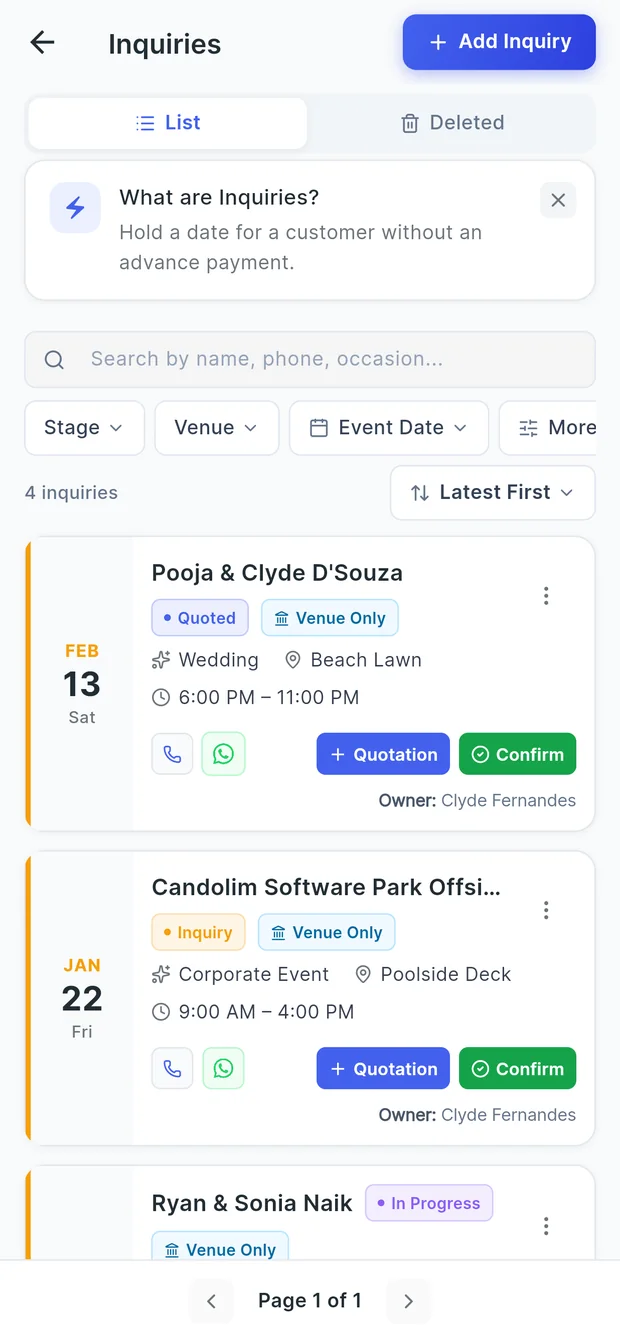
Skip the spreadsheet: quote from your phone
Every quote starts from the enquiry you already logged, so the client, date and guest count are filled in. Venura adds GST worked out and sends the PDF on WhatsApp or email. Free for 30 days.
Screens from the Venura app, set up as a demo resort in Candolim. The clients and amounts are made up.
What Venura handles once the quotation is accepted
The worksheet above is enough to price and send a quote. Venura carries the same numbers forward into receipts, tax and books, so nothing is re-typed after approval.
Totals and GST while you edit the quote
Change a line rate or the guest count and the totals and GST on the quotation recalculate before you send it. Keep the margin check in the worksheet above, because Venura's quote holds selling prices only.
Quotation PDF on WhatsApp
The app uploads the branded PDF and opens WhatsApp with the link in a prefilled message, instead of exporting from Word and attaching it by hand.
A receipt for every milestone
Each 40-40-20 payment is recorded on the booking and gets a payment receipt PDF. It is not a Section 31(3)(d) voucher, so issue that separately where GST is due on the advance.
Composite GST invoice with Tally Prime export
The approved quotation converts to a confirmed booking, which creates a draft GST invoice when GST is on, and sales and receipt vouchers export to Tally Prime.
Tentative hold on the date
When the event sits in a venue you manage, the date can be held as a tentative booking that expires after the days you set unless it is confirmed.
Verified Operator Feedback
What venue owners say about Venura
“Venura transformed how we manage our venue. Bookings, payments and staff—everything is now in one place.”

Z-Square Banquets
Venue on Venura
“We stopped chasing advances on WhatsApp. Every payment, receipt and pending balance now lives in one ledger.”

Salle 59
Venue on Venura
“Quotations that used to take an evening now go out over WhatsApp in a minute. Our close rate went up with it.”

Grand Celebrations
Venue on Venura
Modernize your event management quotation operations
Manage bookings, payments, and receipts with Venura today.
Frequently Asked Questions
Frequently Asked Questions: event management quotation
Everything you need to know about event management quotation for Indian venue, banquet, and catering operations.
An event quote is a written price offer for a defined scope, guest count and date, valid for a fixed number of days. It lists each service with quantity and rate, states what is excluded, shows GST and sets the payment milestones. Once the client approves it, it becomes the reference for every later change request, which is why vague wording costs planners money.
Complete Venue, Catering & Document Infrastructure
Free business templates, specialized software guides, and city hubs for venue owners across India.
Related In-Depth Guides & Tools
Topic-Matchedestimate format
Estimate format with a priced sangeet-night example: likely range, printed assumptions, mixed GST and an estimate-vs-actual tab. Free Excel and Word download.
View Format & Guidebilling-templatesevent proposal template
Free event proposal template in Word with a full 300-guest corporate sample: run of show, 3 priced options with the maths, GST, TDS and payment terms.
View Format & Guidebilling-templatesquotation format
Quotation format with a priced venue example: line-wise 18% GST, validity date, revision numbers and 25-50-25 milestones. Free Excel and Word download.
View Format & Guidebilling-templatesinvoice format in word
Invoice format in Word with GST: download an editable invoice, a mail-merge version and an Excel data file that calculates CGST, SGST and IGST for you.
View Format & GuideFree Formats & Calculators
- Word Invoice (.doc)Editable Microsoft Word billing file
- Banquet Hall Bill FormatPrint-ready A4 banquet invoice
- Event Quotation FormatItemized estimate with advance terms
- GST Tax Invoice Format18% / 5% GST compliant tax bill
- Token Advance SlipDeposit receipt with balance tracking
- Catering AgreementClient & raw ingredient contract
Venura Operating Systems
Ready to modernize your event business?
Explore the Venura ecosystem or speak with our team.