How to Start a Catering Business in India: FSSAI, Kitchen Setup, Staff & Software (2026 Guide)

Co-Founder & CEO, Venura
Build tiered menu packages, 1-tap WhatsApp quotes & track due payments.
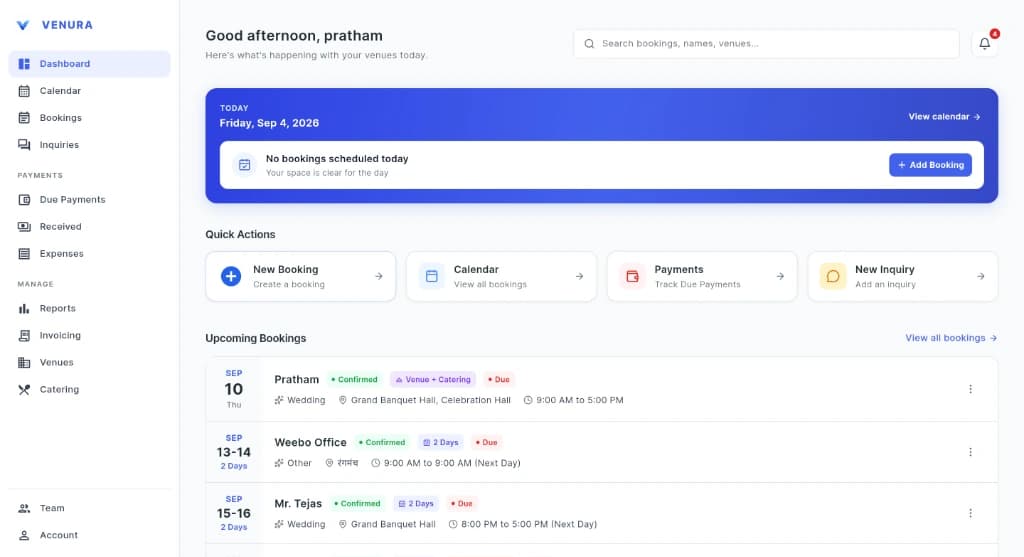
Venura Catering OS replaces kitchen chaos with automatic menu portioning, zero-loss advance tracking, and WhatsApp billing.
How to Start a Catering Business in India: FSSAI, Kitchen Setup, Staff & Software (2026 Guide)
Capital Expenditure (CapEx) Breakdown for a Central Production Kitchen
A commercial central kitchen capable of catering up to 1,500 PAX daily requires approximately 1,500 to 2,500 sq. ft. of industrial space. Here is the realistic capital allocation:
Commercial SS-304 prep tables, high-pressure four-burner Indian/Chinese ranges, double clay tandoors, 50kg spiral dough kneaders, potato peelers, and vegetable cutters.
Commercial two-door reach-in chillers (2°C to 8°C), deep freezers (-18°C) for paneer and frozen goods, and temperature-controlled dairy storage.
High-velocity centrifugal exhaust fans, stainless steel grease extraction hoods, three-sink commercial scullery sanitization station, and masonry grease interceptors.
Commercial insulated food carriers (Cambro hot boxes), stainless steel buffet chafing dishes, melamine/bone china crockery sets, and delivery crates.
FSSAI State License, GST SAC 996334 registration, branded chef uniforms, and Venura Cloud Catering OS.
Comprehensive CapEx & OpEx Budget Matrix
The table below outlines the capital investment and monthly operational budget for a mid-scale catering enterprise:
| Investment / Overhead Component | Estimated Setup Cost | Monthly Operating Benchmark | Target Margin / Benchmark |
|---|---|---|---|
| Commercial Kitchen Equipment (SS-304) | ₹5,50,000 – ₹8,50,000 | Depreciation: ₹8,000 / mo | Long-term 10-year asset life |
| Cold Storage & Walk-In Chillers | ₹3,00,000 – ₹5,00,000 | Power utility: ₹18,000 – ₹28,000 / mo | Prevents perishable dairy spoilage |
| Chafing Dishes, Crockery & Transport | ₹2,50,000 – ₹4,50,000 | Breakage replacement: ₹6,000 / mo | Inventory for 600 PAX simultaneous events |
| Commercial Kitchen Lease (2,000 sq ft) | Deposit: ₹1,50,000 – ₹3,00,000 | Rent: ₹40,000 – ₹80,000 / mo | Ground floor industrial/commercial zone |
| Core Culinary Salaries (Chef + 3 Cooks) | — | ₹95,000 – ₹1,50,000 / mo | Permanent salaried culinary core |
| Venura Cloud Catering OS | ₹25,000 – ₹45,000 setup | ₹2,500 – ₹5,000 / mo | Automates KOTs, WhatsApp quotes & Tally sync |
Mandatory Statutory Licenses & Regulatory Approvals
Operating a legal catering business in India requires securing permits across five regulatory bodies:
- FSSAI State Food Business License: Mandatory under the Food Safety and Standards Act, 2006, for caterers with turnover exceeding ₹12 Lakhs/year. Requires potable water laboratory test reports and food handler medical fitness certificates.
- GST Registration under SAC 996334: Mandatory for outdoor event catering, attracting 18% GST with full Input Tax Credit.
- Municipal Health Trade License & NOC: Issued by your local municipal corporation (e.g. BMC, MCD, GHMC, BBMP) verifying kitchen sanitation and grease disposal.
- Fire Safety Certificate & PESO LPG Approval: Approved commercial gas piping manifold connecting external commercial 19kg/47.5kg LPG cylinders.
- Shop & Establishment Act / MSME Udyam: Legal registration granting priority bank credit and legal dispute protection.
Building the Core Culinary Team & Staff Ratios
Structure your kitchen operations with a disciplined culinary hierarchy:
- Executive Head Chef (Ustad / Master Chef): Oversees master recipe consistency, spice balances, and tasting trial presentations.
- Specialized Station Cooks: 1 Halwai (Traditional Indian Sweets & Desserts), 1 Tandoor Specialist, and 1 Main Gravy/Curry Cook.
- Kitchen Prep Helpers (Daily Contract): 4 to 8 utility helpers for vegetable chopping, onion peeling, and raw ingredient portioning.
- Event Serving Stewards (Contract Agency): Deploy 1 trained steward per 25–30 buffet guests on event day.
Scaling Operations with Venura Catering OS
Venura transforms catering operations from day one:
- Instant WhatsApp Proposals: Generate branded multi-course menus with live margin sliders in under 45 seconds during client tasting trials.
- Automated PAX-to-kg KOT Engine: Converts confirmed guest counts into exact raw grocery weights, cutting food waste from 20% down to 5%.
- One-Click Tally Prime Sync: Exports complete sales journals and customer ledgers directly into Tally Prime.
Food Safety Management System (FSMS) & Hygiene Protocols
Maintaining rigorous food safety is mandatory to protect client health and brand reputation:
- 1Potable Water Filtration: Install commercial Industrial Reverse Osmosis (RO) plants (500 LPH capacity) with quarterly laboratory water test certificates compliant with IS 10500 standards.
- 2Food Handler Medical Fitness: Ensure all permanent cooks, helpers, and stewards undergo mandatory bi-annual medical health checks (including Typhoid, Hepatitis A, and skin swabs) as mandated by FSSAI.
- 3Color-Coded Chopping Board Protocol: Enforce standard HACCP color coding: Red for Raw Meat/Poultry, Green for Fresh Vegetables/Salads, Yellow for Cooked Meats, and White for Dairy/Paneer to eliminate cross-contamination.
Catering Quotation Builder
Build itemised catering quotations by menu, PAX count, and per-plate margin.
Pratham Shankwalker
Co-Founder & CEO, Venura
2nd-generation venue operator with deep operational experience managing 500+ capacity banquet halls, auspicious date shift scheduling, and municipal compliance across Indian wedding venues.
Common Operational Questions
What is the minimum investment required to start a catering business in India?
A boutique catering business can be launched with ₹5 Lakhs to ₹8 Lakhs by renting a shared cloud kitchen and hiring event equipment. A full-scale commercial central kitchen capable of catering 1,000+ guest weddings requires ₹12 Lakhs to ₹20 Lakhs in capital expenditure.
Which FSSAI license is required for an outdoor catering business?
Caterers with annual turnover between ₹12 Lakhs and ₹20 Crores require an FSSAI State License. Businesses with turnover exceeding ₹20 Crores or operating across multiple states require an FSSAI Central License.
What is the average profit margin in the Indian wedding catering industry?
Indian wedding catering yields gross profit margins of 35% to 48% on food production. After deducting fixed kitchen rent, permanent chef salaries, transport fuel, and marketing overheads, net operating profit margins average 18% to 26%.
How does catering software help new catering startups scale?
Venura automates tasting proposals, calculates exact raw mandi grocery weights from guest counts, tracks milestone payments on WhatsApp, and manages multi-event dispatch schedules effortlessly.
Put These Systems to Work in Venura Catering OS
Stop relying on fragile manual registers and Excel sheets. Run your entire booking pipeline, advance collection, and staff permissions on Venura.
Table of contents
Book a demo→
Get a personalized demo tailored to your use case.
Ready to modernize your event business?
Explore the Venura ecosystem or speak with our team.