Acoustic Treatment for Banquet Halls: Eliminating Echo & Sound Bleed Between Halls (2026)

Co-Founder & CEO, Venura
Stop double bookings, manage hall calendars & automate GST bills.
Venura Venue OS unifies multi-hall booking calendars, token advances, and Tally Prime ledgers in real time.
Acoustic Treatment for Banquet Halls: Eliminating Echo & Sound Bleed Between Halls (2026)
The 2 Core Acoustic Challenges: Echo vs Sound Bleed
Banquet venue acoustics involve solving two distinct physical phenomena:
Hard reflective surfaces (marble tiles, concrete walls, mirrors) cause sound to bounce, creating high RT60 (2.5 to 3.5 seconds). Guests struggle to hear speeches over the microphone. The ideal acoustic benchmark for an Indian banquet hall is RT60 between 0.8 and 1.1 seconds.
Sound energy traveling through dividing walls between adjacent halls. To prevent a 95 dB DJ sound rig in Hall A from disrupting an event in Hall B, dividing walls must achieve an STC rating of at least 55 to 60 dB.
Acoustic Materials & Engineering Specifications Matrix
The table below outlines standard acoustic treatments and technical ratings for banquet ballrooms:
| Acoustic Treatment Area | Recommended Material & Thickness | Acoustic Metric / Rating | Target Operational Function |
|---|---|---|---|
| Ballroom Perimeter Walls | Fabric-Wrapped High-Density Glass Wool Panels (50mm) | NRC 0.85 – 0.95 | Absorbs mid and high-frequency speech & musical reflections |
| False Ceiling Surface | Perforated Acoustic Gypsum / Mineral Fiber Tiles | NRC 0.75 – 0.85 | Prevents vertical sound bouncing towards marble flooring |
| Multi-Hall Dividing Partition | Double-Stud Drywall with 100mm Rockwool & Green Glue | STC 55 – 60 dB | Eliminates bass and acoustic sound bleed between adjacent halls |
| Sliding Operable Partitions | Acoustic Motorized Movable Walls with Drop Seals | STC 48 – 52 dB | Flexible hall subdivision with sound-tight perimeter sealing |
| Heavy Entry Doorways | Solid-Core Acoustic Fire Doors with Perimeter Gaskets | STC 42 – 45 dB | Blocks sound leakage into reception foyers and outdoor lawns |
Step-by-Step Acoustic Retrofit Guide for Existing Venues
Upgrading an existing reverberant banquet hall without full reconstruction:
- Step 1: Install Fabric-Wrapped Wall Panels: Mount 50mm high-density (48 kg/m³) fabric-wrapped fiberglass acoustic panels covering at least 35% of total perimeter wall surface area.
- Step 2: Install Bass Traps in Corners: Mount vertical acoustic bass traps in 90-degree room corners to absorb low-frequency 60Hz–120Hz bass rumble from DJ subwoofers.
- Step 3: Carpet the Dining & Foyer Zones: Lay heavy commercial cut-pile carpet with high-density underlay in pre-function foyers to eliminate footfall noise.
- Step 4: Seal Door Perimeters: Install heavy-duty automatic mechanical drop seals on the bottom of all entry doors.
Acoustic Scheduling & Sound Conflict Prevention with Venura OS
Prevent acoustic conflicts through intelligent software scheduling:
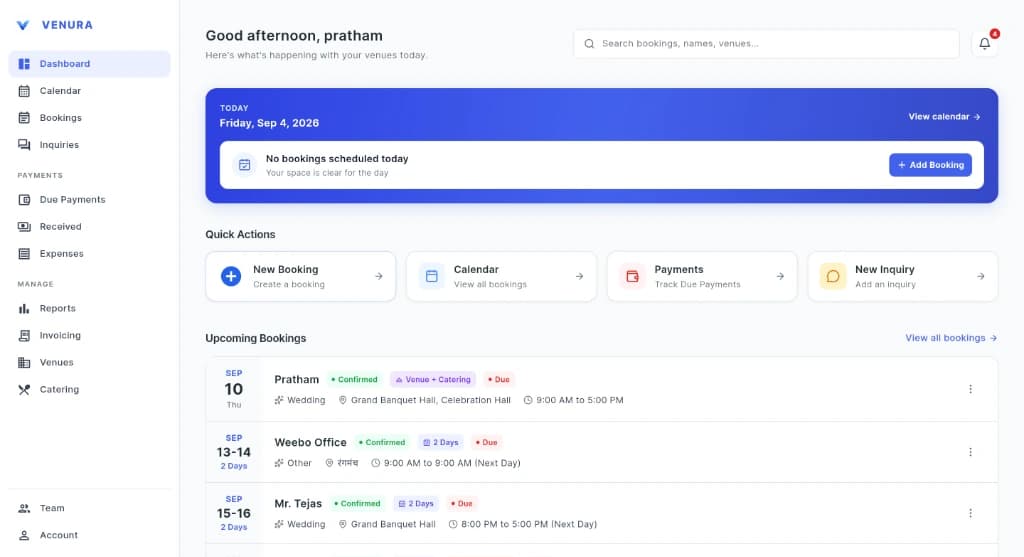
- Acoustic Sound Bleed Warnings: Venura flags potential sound conflicts if two high-wattage DJ events are scheduled in adjacent partitionable halls simultaneously.
- Speaker Decibel Limit Policy: Enforces contractual sound limits (max 85 dB for indoor ballrooms) and automated curfew countdowns.
HVAC Duct Acoustic Attenuation & Silencer Baffles
Eliminating air conditioning fan rumble and airflow noise:
- 1Acoustic Duct Lining: Line the interior of supply and return air ducts with 25mm fiberglass acoustic insulation to absorb mechanical fan noise.
- 2Crosstalk Silencer Baffles: Install sound attenuator baffles in ductwork connecting adjacent ballrooms to prevent voice transmission through ventilation shafts.
- 3Low-Velocity Air Diffusers: Use oversized linear slot diffusers operating below 400 FPM (feet per minute) to ensure whisper-quiet air distribution during keynote speeches.
Stage & Podium Audio Calibration Protocols
Optimizing sound delivery from microphones and PA systems:
- 1Line-Array Speaker Directivity: Position line-array speakers angled downward towards audience seating, minimizing sound spill onto reflective rear walls.
- 2Digital Signal Processing (DSP) Equalization: Calibrate digital sound processors with parametric EQ filters to notch out room resonant frequencies.
- 3Venura Vendor Sound Agreements: Requires DJ sound crews to sign acoustic compliance addendums capping master output at 85 dB.
Managing Outdoor Lawn Acoustic Dispersion & Boundary Walls
Controlling sound pollution in outdoor wedding lawns:
- Dense Green Foliage Buffers: Plant dense evergreen ficus and bamboo hedges along property boundaries to naturally absorb and scatter high-frequency musical spill.
- Directional Sound Arrays: Position main stage speaker stacks facing inward towards the central dining area rather than toward perimeter residential zones.
- Venura Noise Compliance Timer: Monitors decibel limits on mobile, alerting floor managers before municipal noise curfews.
Acoustic Testing & Decibel Certification Audits
Verifying acoustic performance before commercial handover:
- RT60 Sound Meter Testing: Conduct calibrated pink noise acoustic decay measurements across 8 ballroom grid points, verifying RT60 is below 1.1 seconds.
- STC Sound Isolation Certificate: Obtain a formal Sound Transmission Class certificate from an empaneled acoustic consultant to satisfy municipal environmental clearances.
Interactive Booking Calendar & Conflict Simulator
Simulate live shift locking, double-booking prevention, and multi-hall acoustic conflict alerts.
Pratham Shankwalker
Co-Founder & CEO, Venura
2nd-generation venue operator with deep operational experience managing 500+ capacity banquet halls, auspicious date shift scheduling, and municipal compliance across Indian wedding venues.
Common Operational Questions
What is the ideal reverberation time (RT60) for a banquet hall?
The ideal Reverberation Time (RT60) for an Indian banquet hall is between 0.8 and 1.1 seconds. An RT60 below 1.1 seconds ensures microphone speeches are crystal-clear while music retains natural warmth.
How can you stop DJ sound from leaking between two adjacent banquet halls?
To stop sound bleed between adjacent halls, construct a double-stud partition wall filled with 100mm high-density rockwool (64 kg/m³) and double layers of 15mm acoustic drywall dampened with viscoelastic damping compound, achieving an STC rating of 55+ dB.
What percentage of wall surface should be covered with acoustic panels in a banquet hall?
To eliminate flutter echo and achieve speech intelligibility, cover approximately 30% to 40% of the total perimeter wall surface area with 50mm fabric-wrapped acoustic panels (NRC 0.85+).
How does venue management software assist in acoustic conflict management?
Venura OS includes an intelligent space conflict engine that warns sales staff if two high-noise events (such as two concurrent DJ Sangeet parties) are booked in adjacent acoustically connected spaces.
Put These Systems to Work in Venura Venue OS
Stop relying on fragile manual registers and Excel sheets. Run your entire booking pipeline, advance collection, and staff permissions on Venura.
Table of contents
Book a demo→
Get a personalized demo tailored to your use case.
Ready to modernize your event business?
Explore the Venura ecosystem or speak with our team.