How to Start an Event Management Business in India: Legal Registration, Vendor Alliances & Pricing (2026)

Co-Founder & CEO, Venura
Stop double bookings, manage hall calendars & automate GST bills.
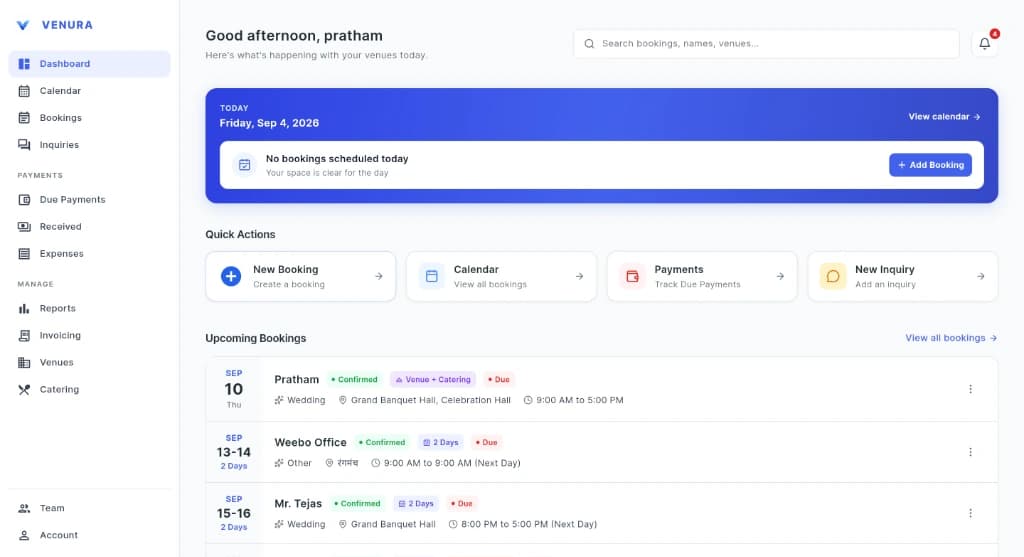
Venura Venue OS unifies multi-hall booking calendars, token advances, and Tally Prime ledgers in real time.
How to Start an Event Management Business in India: Legal Registration, Vendor Alliances & Pricing (2026)
Legal Entity Registration & Statutory Tax Setup
To build a legitimate, bankable event management brand in India, complete these foundational registrations:
Event management, coordination, and artist booking services fall under SAC 998397 (Other Professional, Technical & Business Services), attracting an 18% GST rate (9% CGST + 9% SGST or 18% IGST). GST registration is mandatory once turnover crosses ₹20 Lakhs.
Provides priority bank credit, collateral-free loans under the CGTMSE scheme, and statutory protection against corporate payment delays under the MSMED Act, 2006 (mandating corporate payments within 45 days).
Open a dedicated current account for client funds separate from operational salary accounts, ensuring client event advances are never commingled with overhead expenses.
Agency Pricing Models: How to Structure Fees for Maximum Margin
Indian event planners structure client billing across four distinct pricing models:
| Pricing Structure | Fee Formula | Best Suited For | Target Net Margin |
|---|---|---|---|
| Percentage of Total Spend | 10% – 15% of gross event budget | Luxury weddings (Budget ₹50L – ₹5Cr) | 12% – 18% net |
| Flat Project Retainer | ₹75,000 – ₹3,50,000 fixed fee | Social birthdays, corporate offsites | 35% – 50% net |
| Hybrid Retainer + Vendor Markups | ₹1.5L retainer + 5%–10% vendor margin | Mid-market weddings (Budget ₹20L – ₹45L) | 20% – 28% net |
| Turnkey All-Inclusive Package | Direct markup on bundled services | Corporate product launches & AGMs | 25% – 35% net |
Building the 3-Tier Preferred Vendor Network
An event planner's reputation depends entirely on the reliability of their vendors. Structure relationships into three distinct tiers:
- Tier 1: Core Production Partners (Stage, Sound & Décor): Partner with 2 primary floral designers, sound engineers, and truss fabricators. Negotiate master service agreements with a guaranteed 10%–15% trade discount and strict 4-hour post-event breakdown timelines.
- Tier 2: Creative & Artisanal Talents (Photo, Video, Emcees & Choreographers): Maintain a roster of 4 wedding photographers, 3 traditional mehendi artists, and 2 professional corporate emcees categorized by budget tier (Budget, Premium, Luxury).
- Tier 3: Emergency Utility Vendors (DG Backup, Valet & Fabrication): Standby contracts for emergency 125kVA generator sets, misting fan rentals, and water tankers with a guaranteed 60-minute dispatch SLA.
Client Contract Protection: Clauses That Safeguard Your Agency
Never commence event planning without a signed Service Agreement containing these four protective clauses:
- 1Strict 3-Stage Milestone Payment Schedule: 30% advance on signing, 50% due 30 days prior, and final 20% balance cleared 72 hours before event setup commences. Zero execution without 100% advance clearance.
- 2Overtime & Scope Creep Clause: Any event extension past midnight or additional guest count overruns (> 10% of agreed PAX) billed at ₹15,000 per hour plus actual vendor surcharges.
- 3Rain & Weather Disclaimer: Outdoor events mandate a client-funded waterproof canopy contingency plan. The agency is not liable for weather-related disruptions without approved rain infrastructure.
- 4Force Majeure & Non-Refundable Retainer: Initial 30% booking retainer is 100% non-refundable to cover agency staff time, 3D render design, and initial vendor lock-in deposits.
Event P&L & Vendor Expense Ledger
Track every vendor payout, expense, and client milestone to know your true event net profit.
Pratham Shankwalker
Co-Founder & CEO, Venura
2nd-generation venue operator with deep operational experience managing 500+ capacity banquet halls, auspicious date shift scheduling, and municipal compliance across Indian wedding venues.
Common Operational Questions
What is the minimum initial capital required to start an event management agency in India?
An event management agency can be launched with ₹1.5 Lakhs to ₹5 Lakhs in starting capital, covering company incorporation, professional branding, 3D design software licenses, initial website SEO setup, and legal client contract drafting. The business operates with low fixed assets since production equipment is rented from specialized vendors.
What is the difference between an event planner and a wedding coordinator?
An event planner manages the entire lifecycle from budget conceptualization, venue selection, theme styling, vendor negotiations, and multi-month timeline management. A wedding coordinator handles on-day logistics (Baraat timing, vendor arrivals, runsheet execution, and guest hospitality) during the final 30 days leading up to the event.
Can an event management company claim Input Tax Credit on vendor invoices?
Yes. Registered event management companies charging 18% GST under SAC 998397 can claim full Input Tax Credit (ITC) on B2B invoices received from registered audio-visual providers, stage decorators, lighting fabricators, and equipment rental suppliers.
How does venue and event software help new event planners scale?
Venura provides integrated runsheet planners, client milestone payment tracking, instant branded quotation generators, and real-time vendor expense ledgers, enabling solo founders to manage multiple concurrent events without operational chaos.
Put These Systems to Work in Venura Venue OS
Stop relying on fragile manual registers and Excel sheets. Run your entire booking pipeline, advance collection, and staff permissions on Venura.
Table of contents
Book a demo→
Get a personalized demo tailored to your use case.
Ready to modernize your event business?
Explore the Venura ecosystem or speak with our team.