7 Financial Ratios Every Banquet Hall Owner Must Track: RevPAH, EBITDA & Labour Ratio (2026)

Co-Founder & CTO, Venura
Stop double bookings, manage hall calendars & automate GST bills.
Venura Venue OS unifies multi-hall booking calendars, token advances, and Tally Prime ledgers in real time.
7 Financial Ratios Every Banquet Hall Owner Must Track: RevPAH, EBITDA & Labour Ratio (2026)
The 7 Core Financial Metrics for Banquet Venues
Every profitable venue operator must monitor these seven core financial ratios:
- 1RevPAH (Revenue Per Available Hour): Total Event Revenue divided by (Total Operational Hours in Month x Number of Distinct Event Spaces). Measures spatial asset utilization across morning, evening, and weekday slots.
- 2Food Cost Percentage (Target: 30% – 34%): (Raw Food & Grocery Procurement Cost / Total Catering Revenue) x 100. Measures kitchen recipe yield and prevents mandi purchasing waste.
- 3Direct Labor Cost Ratio (Target: 12% – 16%): (Total Service Stewards, Kitchen Cooks & Floor Staff Wages / Total Event Revenue) x 100.
- 4EBITDA Operating Margin (Target: 32% – 42%): Earnings Before Interest, Taxes, Depreciation, and Amortization as a percentage of gross turnover.
- 5Utility Cost Per Event Hour (Target: ₹1,200 – ₹2,200 / hr): (Electricity Units + DG Diesel + Water Tankers) / Total Operational Event Hours.
- 6Debt Service Coverage Ratio (DSCR — Target: > 1.75x): Net Operating Cash Flow / Annual Principal & Interest Bank EMI.
- 7Off-Season Cash Reserve Ratio (Target: 35% Sinking Fund): Percentage of winter profits retained in liquid reserves to fund the 4-month monsoon/Pitru Paksha operational trough.
Financial Metrics Benchmark & Diagnostic Matrix
The table below outlines healthy vs alarming financial benchmarks for a 10,000 sq. ft. Indian banquet property:
| Financial Ratio / Metric | Healthy Target Benchmark | Warning / Deficit Threshold | Corrective Action SOP |
|---|---|---|---|
| RevPAH (Revenue / Avail. Hour) | ₹2,500 – ₹4,200 / hour | < ₹1,500 / hour | Monetize quiet weekday slots with corporate Day Delegate packages |
| Food Cost Percentage | 30.0% – 34.0% | > 38.0% | Enforce 70/30 batch cooking and per-head grammage sizing |
| Direct Labor Ratio | 12.0% – 16.0% | > 22.0% | Replace permanent staffing with flexible shift-contracted stewards |
| EBITDA Operating Margin | 35.0% – 42.0% | < 22.0% | Audit utility submeters and renegotiate vendor trade discounts |
| Utility Cost / Event Hour | ₹1,400 – ₹1,800 / hour | > ₹2,600 / hour | Install APFC panels and enforce 1-hour AC pre-cooling limits |
| Debt Service Coverage (DSCR) | 1.75x – 2.25x | < 1.30x | Restructure term loans via Lease Rental Discounting (LRD) |
| Off-Season Reserve Ratio | 35.0% of peak profit | < 15.0% | Lock sinking fund reserves; restrict personal owner drawings |
The RevPAH Maximization Strategy
How to increase Revenue Per Available Hour across quiet periods:
- Dual Shift Partitioning: Host a Morning Mandap (07 AM – 03 PM) and Evening Reception (05 PM – 01 AM) on peak Muhurat dates to double daily RevPAH.
- Corporate Weekday Packages: Offer Day Delegate Rates (₹1,450/PAX) for Tuesday–Thursday corporate seminars.
- Lifestyle Exhibitions: Lease empty ballroom space for 2-day consumer lifestyle and jewelry exhibitions during off-peak weeks.
Tracking Financial KPIs with Venura OS
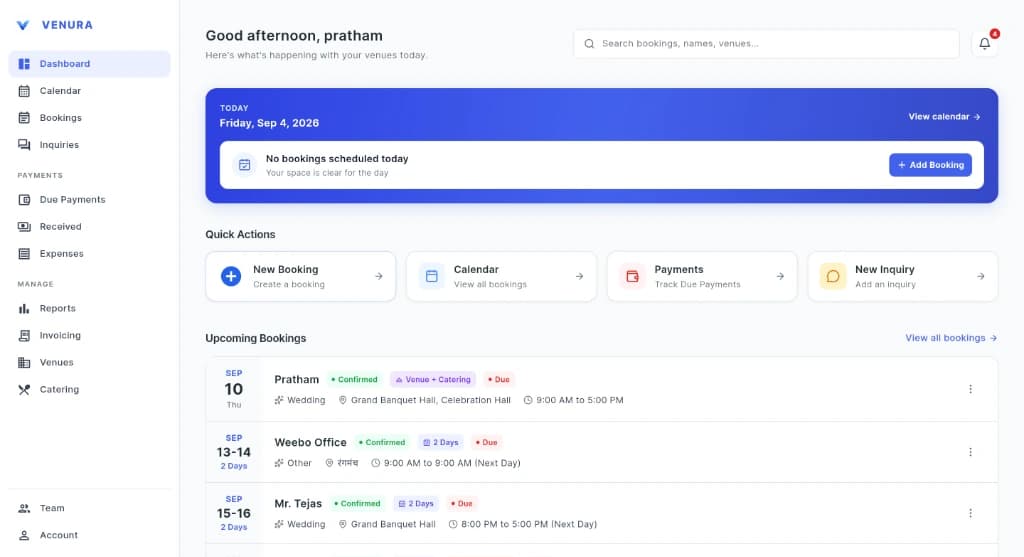
Venura provides real-time executive financial dashboards:
- Live RevPAH & Gross Margin Sliders: Monitors per-event profit margins and spatial occupancy in real time.
- Automated Food & Labor Ratios: Automatically computes food cost percentages from kitchen KOTs.
- One-Click Tally Prime Sync: Exports audited sales journals, tax ledgers, and vendor payables directly into Tally Prime in seconds.
Labor Productivity & Steward Turnover Metrics
Optimizing front-line service staffing efficiency:
- 1Steward-to-Guest Ratio (1:25 Benchmark): Deploy 1 service steward per 25 guests for wedding buffets and 1 per 15 guests for cocktail pass-around service.
- 2Labor Cost per Covered Guest: Track direct service and kitchen wages per guest plate (target: ₹120 – ₹180 / guest).
- 3Venura Shift Rostering: Automated logging of staff shift hours and wage payouts mapped directly to your event P&L ledger.
Managing Utility Cost Efficiency & APFC Power Factor
Cutting commercial electricity bills during peak wedding seasons:
- 1Automatic Power Factor Controller (APFC): Maintain power factor above 0.98 to eliminate commercial DISCOM low-power-factor penalties.
- 2Enforcing 1-Hour AC Pre-Cooling Limits: Pre-cool ballrooms for a maximum of 1 hour prior to guest arrival to cut power consumption by 25%.
- 3Venura Utility Tracker: Logs electricity units and DG diesel consumption per event hour.
Managing Off-Season Working Capital & Sinking Funds
Protecting venue liquidity during the 4-month monsoon trough:
- The 35% Peak Season Sinking Fund Rule: Transfer 35% of net operating profit generated during peak winter months into a dedicated Off-Season Sinking Reserve Fund.
- Stepped Commercial Leases: Negotiate seasonal stepped leases (higher winter, lower monsoon) with property landlords.
- Venura Cash Flow Analytics: Monitor real-time upcoming receivables and vendor liabilities to prevent liquidity crunches.
Event P&L & Vendor Expense Ledger
Track real-time RevPAH, food cost percentages, EBITDA margins, and vendor expenses.
Sumeet Yadav
Co-Founder & CTO, Venura
Systems architect specializing in GST compliance automation, Tally Prime ledger synchronisation, and enterprise financial access control for Indian hospitality and catering enterprises.
Common Operational Questions
What is RevPAH in banquet hall management?
RevPAH (Revenue Per Available Hour) is the primary metric measuring how effectively a venue monetizes its physical space over time, calculated by dividing total event revenue by total available operating hours across all rentable halls.
What is a healthy food cost percentage for a wedding caterer in India?
A healthy food cost percentage for an Indian wedding caterer is between 30% and 34% of the per-plate price. A food cost exceeding 38% indicates severe raw ingredient over-procurement, cooking shrinkage losses, or buffet wastage.
What is a healthy EBITDA margin for an Indian banquet hall?
A well-managed Indian banquet hall targets an EBITDA operating margin of 35% to 42% on gross revenue during peak operational seasons, and 28% to 35% annually after factoring off-season overheads.
How does venue management software track financial metrics?
Venura OS tracks real-time event revenue, calculates recipe food costs, monitors staff labor ratios, and exports Tally Prime financial ledgers automatically.
Put These Systems to Work in Venura Venue OS
Stop relying on fragile manual registers and Excel sheets. Run your entire booking pipeline, advance collection, and staff permissions on Venura.
Table of contents
Book a demo→
Get a personalized demo tailored to your use case.
Ready to modernize your event business?
Explore the Venura ecosystem or speak with our team.